Claude vs GPT-6 Astra: What I Kept, What I Cut
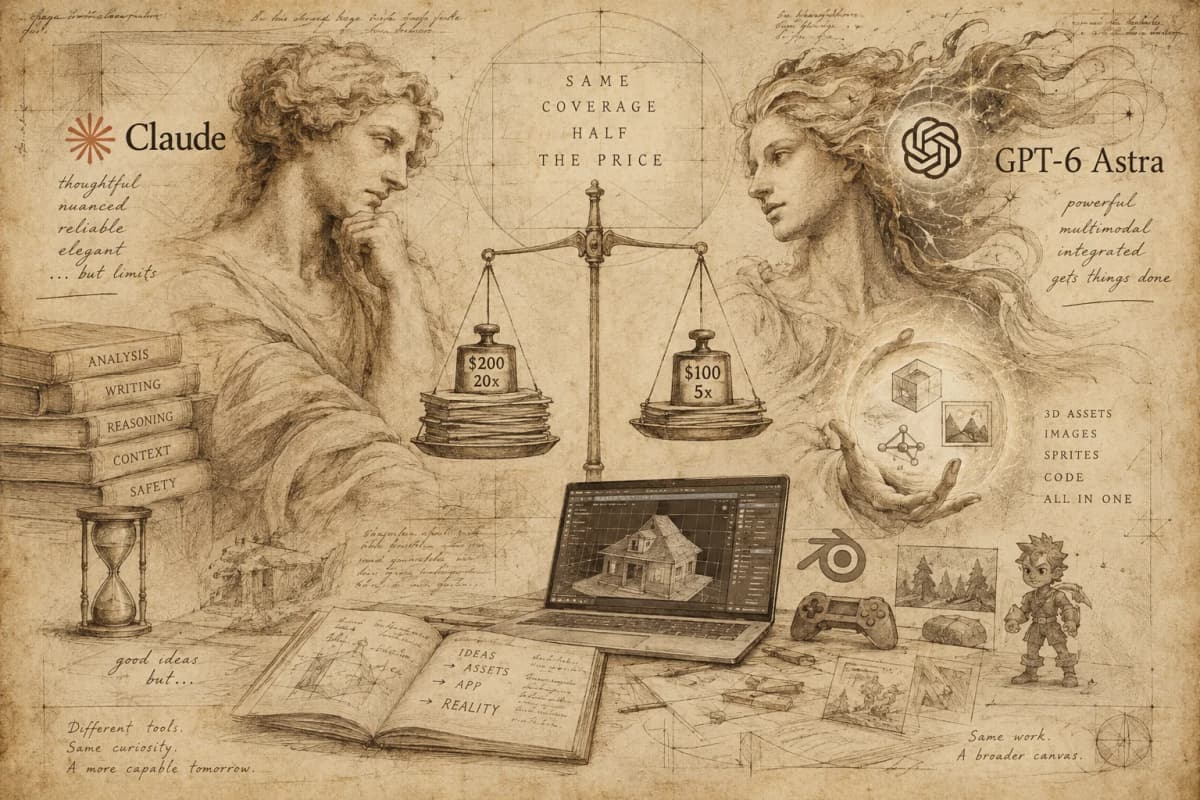
This is the full breakdown behind the LinkedIn post. No winner declared. Just the spreadsheet I ran when my subscription decision stopped being theoretical.
Why I ran the test
I was an Anthropic loyalist, and not casually. For a long stretch the models were better and the experience of talking to them was better. But two things forced my hand.
First, the subscription became a problem. Claude Max 20x at $200 a month kept stalling me out midweek. I'd burn through the week's quota and limp along on a lower model until it reset. That's not a pricing complaint, it's a throughput problem at the exact moments I needed it.
Second, my client subscription ends next month. So the question stopped being "which do I prefer" and became "what am I actually going to pay for out of my own pocket." When it's your own money, you test properly.
What I compared
GPT-6 Astra against Claude Max, with the thinking effort cranked high on both sides. No cost-saving strategies, no gaming the limits. Same workload, same week.
The headline result: Astra on OpenAI's $100 Pro 5x plan covered the same number of working days per week as Claude Max 20x at $200.
That's already worth pausing on. Half the price, same coverage. But there's a second layer that makes the gap wider.
Claude Max caps you at 50% of your weekly quota on Opus-level thinking before you have to switch to a different model. Astra lets you run the full weekly limit on the one model. So the $200 plan isn't just more expensive, it's also structurally throttled in a way the cheaper plan isn't.
Price, coverage, and throttle. Three separate things, and Astra won the first two and tied the third.
The reason I tested at all: I prep codebases for agentic coding, so a model has to work inside my actual setup, not in a clean benchmark. See how I help teams.
3D assets felt like dark magic
The thing that surprised me most was the 3D asset generation.
I gave Astra access to my local Blender install. It used it directly: builds proper 3D assets, exports them optimized, and they're ready to drop into the app. Not a preview, not a mockup. The actual asset, in the actual pipeline.
That was a genuine leap past what I could get Anthropic models to do. And it showed up exactly where my side projects live.
One subscription replaced a small ecosystem
Before this, generating an image meant one of a few clunky paths. Generate it myself in a web UI with nano-banana, export it, import it into the codebase by hand. Or open ChatGPT in a tab and shuffle the result over. Or the easy path: pay for yet another service like Higgsfield to do it.
For the game side projects I'd started, I had subscribed to external services for sprites and 3D assets. That's real money, plural subscriptions, each one doing one thing the model couldn't.
GPT-6 Astra folds all of it into the one subscription. Images natively, because OpenAI's models generate them. Blender-driven 3D assets. Sprites. The services I was paying for separately now have to justify existing.
That's the part that reads like a game changer, and I want to be precise about why: it's not that Astra is a slightly better model. It's that the surface area of what one subscription covers got dramatically bigger.
The part I didn't expect: follow-up issues
Here's a more subjective but honest observation, and it matters more than the assets in day-to-day work.
Anthropic models, in my hands, tended to hand back work with follow-up issues. The PR would be 90% there and leave little dangling things for the next round. Progress, but not closure.
Astra pushed things to the finish line instead. Fewer little multiplications of work that spawn their own fixes.
I've tried to hold that observation loosely. It's not a benchmark, it's repeated experience across my codebase and my workflows. But when you're billing by the hour and the difference between "almost done" and "done" is another round of review, it compounds fast.
What I'm not saying
I'm not declaring a winner. That framing is wrong in the first place. Models move too fast, and what's true this quarter won't survive next quarter.
I'm also not saying you should switch. The right tool depends on your stack, your workflow, and what you're actually paying to get done.
What I am saying: run your own test before you renew anything. For me, right now, one subscription is doing what several tools used to, at half the price I was paying, without the midweek wall.
Available for a new mission
Your app, faster with AI, and still yours.
Over two and a half years leading Odisei Play: one codebase on iOS, Android and web, a release every two weeks, with two developers, a designer and AI agents. That role on your team, or the AI setup that makes the pace possible.